ENGLISH
The footnote links do not work; you will have to scroll down to to the footnotes for expanded information. Opening the blogsite on two seperate windows and keeping one on the footnotes will make it easier to go back and forth. Sorry for the inconvenience, I'm no expert!.
Other links should work.
August 5th 2013; the notorious Ergenekon conspiracy case was slated to to have its final hearing
and pass out its verdicts.
The Ergenekon “conspiracy”
trials is itself a great conspiracy, a major operation launched by US/Globalist
interests in a grand scheme to rearrange the Middle East according to their own
interests.
It does not help
here to say that one does not believe in conspiracy theories because the trials
are very real, have been going on for years, and disbelieving one conspiracy precludes disbelieving the other. Either
you believe the AKP government’s thesis that there has been a conspiracy, or
disbelieve it and subscribe to the alternate view that that whole conspiracy is
a fiction created to serve another conspiracy!
The thesis of the AKP regime and its supporters has been
that a terror organisation called Ergenekon
has been attempting to overthrow the democratically elected government by
force, and that this organization has been behind similar plots and
conspiracies against the legitimate wishes of the population, said plots including but not
confined to the previous military coups. This has been the legitimization of
the arrest and incarceration of literally hundreds of the best of Turkey’s
elite, comprising journalists, academicians, officers and intellectuals.
With effective control over the media, whose complicity
was purchased through advantageous business deals and a blind eye to tax evasion,
public opinion was lulled into credulity and apathy. Dissident voices were few
enough to be allowed to go on publishing and broadcasting their anti-government views;
that much was necessary to maintain the illusion abroad of a liberal democracy-
but not so far as to preclude clampdowns if the AKP felt threatened!
The globalist/capitalist interests which the AKP serves,
and in whose service it has come to power, have provided Turkey with the sparkle
and glitter proper to their image. A rash of shopping centers mushrooming all
overn the land- some next to each other, some smack in the middle of an already bustling
shopping street, offer nothing but the same names: LCWaikiki, McDonald’s, Miss
Selfridge, Media Markt, Sephora, Saturn, Body Shop, Marks & Spencer, Pizza Hut etc.
etc., plus a smattering of Turkish chains like Remzi Kitabevi, Teknosa, and
Paşabahçe. The purchasing power is
obligingly provided by banks (all but two already under foreign ownership) that
shower their clients with credit cards, with the net result that most of the
population is heavily in debt and people are fearful of any social upheaval that may
send their interests up through the roof, so complacency seems the best option.
Seeing the Ergenekon
witchhunt going so well, the AKP supplemented it with others, most famously
with the Balyoz (“Sledgehammer”) coup
plot allegation which decimated the commanding staff of the navy, but also
others like the espionage trials targeting younger officers and the “28th of
February” trials against the anti-fundamentalist National Security Council
resolutions of February 28th, 1997.
Turkey has been a NATO ally of the United States
since February 18th, 1952, and relations
have sometimes suffered from anti-American sentiment among left-wing youth. There were times when
relations soured with the Turkish establishment as well, such as US arms
embargo against Turkey following the Turkish military operation in Cyprus in
1974. The embargo prompted Turkey to nationalize most NATO bases in the country. Still, relations have
remained fairly stable until the end of the Cold War.
Turkey’s political scene was heavily influenced by the
cold war: Turkey shared borders with Warsaw-pact nation Bulgaria on the west
and the Soviet Union itself on the east, and Turkey’s armed forces were the
second largest in NATO.
The unrest and violence on the streets in Turkey that led
up to the three military interventions in 1960, 1970 and 1980 may all be
interpreted as the cold war turning hot on a smaller scale. Real issues became
confused with ideologies, facts with myths, doubletalk from all sides blurred realities until no one was quite sure what one was fighting for. The reaction to
heavy US influence which appealed at first to nationalist sentiments with
slogans like “Neither the USA nor Russia, a fully independent Turkey”, later drifted
towards an “internationalist” outlook which eschewed nationalism and national
symbols, and discredited Ataturk and his republic almost as much as the AKP is
doing right now.
So long as the Cold War continued, the left was
susceptible to influences from the Eastern Block, primarily the Soviet Union
but also China, which is most probably the reason for the progressive de-nationalization and
internationalization of the leftist movements, leaving the “defense of the
flag” to the right.
When factional violence became too extreme, the cost in
lives too high, the Armed Forces intervened- as they have in 1960, 1970 and
1980. I refrain from using the
term “coup d’état” because none of these interventions aimed at changing the
regime, but were actions taken in
extremis when civil war was imminent and, in the case of the 1980
intervention, had already started. If anything, the purpose was a return to the status quo. Though all three military interventions were
against right-wing governments, there was fear of the chaos leading to a left-wing
revolution, so they had the acquiescence of the US.
The cold war ended with the collapse of the Soviet empire
and the domino-effect dissolution of the regimes of the sattelite states. I was
working at a studio in West Berlin at the time of the disintegration of East
Germany and witnessed souvenir hunters chipping away bits of the Berlin Wall
piece by piece. I witnessed East German uniforms and Soviet insignia sold off
flea-market style as relics of a bygone age, and was amazed to see the 41 year old
German Democratic Republic blow away like soap bubbles.

Checkpoint
Charlie was a crossing point at the Berlin Wall between the Allied
controlled West Berlin and the Soviet sattelite German Democratic
Republic, or East Germany. When the wall was opened and East Germany
disintegrated, the once strictly controlled Checkpoint Charlie became a
touristy fleamarket where Soviet and East German uniforms, medals and
paraphernalia were sold. Die DDR ist nicht verkauflich ("The German Democratic Republic is not for sale") I had heard a defiant East Gerrman TV commentator say in 1990. Above the shoppers' heads- the flag of the
German Democratic Republic, for sale.
(Image from my own camera, 1991.)
Uniforms of the defunct army of the German Democratic Republic for sale.
(Image from my own camera, 1991.)
The similar collapse of
the gigantic and powerful Soviet Union was likewise unbelievable, but because
for us it was the other side of the fence, it didn’t touch me personally, it
didn’t bother me at all.
After official unification of East and West Germany
on September 3rd 1990 I was again surprised at discontent expressed by the
Germans who had previously clamored for unification with cries of Die Mauer muss Weg!- “The Wall must Go!”.
I did not comprehend the disappointment of the East Germans whose forty-one year
journey had come to naught. This wasn’t “unification”, this wasn't two halves
becoming one, this was one part taking over the other, disbanding its army, its
institutions, automatically transforming the population of the former Deutsche Demokratische Republik into
parvenues living in the Neue Bundesländer-
“New States of the Federation”.
I could only think smugly: “how weak the fabric of
communism! Such a thing is not possible with us, in the Republic of Turkey,
where we fought for and won our own independence, and founded
our own Republic!” Time is a cruel teacher!
Even as the Soviet giant disintegrated, Soviet republics
splitting away in spite of the Red Army’s formidable nuclear arsenal, I never
thought anything of the like could possibly happen to us.
Then strange things started to occur. Being the sole
remaining superower, the US took to flexing its muscles much more than we were
accustomed to seeing. Just before the final dissolution of the tottering Soviet
Union (December 26th, 1991) the Gulf war of 1991 saw the overwhelming military force of the US steamrolling over
Iraq. Turkey’s civilian president
Turgut Özal was all for jumping on the bandwagon; it was the military that
declined to take part in military action. Turkey agreed to allow the use of
NATO bases on its territory during the conflict and moved forces along the Iraqi
border, diverting some valuable Iraqi military resources away from the theater of war, but never went into actual combat. When pressed to accept an
active military role Turkish Chief of Staff Full-General Necip Torumtay resigned
(December 3rd, 1990). The US had gathered a
large coalition of states to participate in, and thus legitimize, the military
action against Iraq, and the army of staunch NATO ally Turkey was not taking
the bait. This did not go down well with Uncle Sam.
With the the Iran hostage crisis of 1979-81 the US recognized
a new threat to its authority, a new force to challenge its might as a world
power- the mysterious eastern religion of Islam, with fanatical suicide
warriors. The mullahs of Iran had overthrown the Shah and established an
autocratic rule, frustrating US attempts at establishing a Pax Americana in the Middle East. The Taliban of Afghanistan, once supported by the US to oust the
Soviets, had turned out to be uncontrollable fanatics forever waging civil war
in an already impoverished country, aiming to maintain and spread an oppressive
medieval lifestyle. With the Soviet threat neutralized, the beast of Islam
seemed the next threat to be dealt with.
Around the same time that the US led “coalition” was
driving into Iraq in order to liberate Kuwait, Yugoslavia was entering a decade
of internal warfare that would split it up into six countries. The oddball in this group
was Bosnia- Herzegovina, a region with a large muslim population. If
the Bosniaks had their way, there would be an independent muslim nation in the
middle of a christian Europe moving towards unification.
Bosnia-Herzegovina
declared its independence on March 3rd 1992, having to fend off the Yugoslav People’s Army of the
essentially Serbian Federal State, the militia of the newly created purely
Serbian Republika Srpska, and on and off with
Croatia, with which it also often allied itself.
Bosnia-Herzegovina was recognized by the US and other
Western nations on April 7th, 1992, one month after declaring independence. Its
application for membership in the United Nations was accepted on May 22nd,
1992. From that point onwards, the Republic of Bosnia and Herzegovina was
entitled to UN protection in case of being aggressed. This had been the pretext
for the US led “coalition” charging into Iraq; to liberate internationally recognized UN member Kuwait from occupation.
The
war dragged on; Muslim Bosnia was strangled by christian Serbs, Sarajevo was
under siege, its population blown up with morter shells or picked off by sniper
fire while Europe and the US prevaricated. The gung-ho readiness for action so
evident in the days leading up to the Gulf War had left its place to humming
and looking the other way. The Yugoslav Federal State had abandoned even the
pretence of trying to preserve the federation; the aim of President Milošević
was a greater Serbia, and the method was “ethnic cleansing”.
The
international community made a show by sending UN peacekeepers who were not
allowed to shoot and fighter planes that were not permitted to fight. “Safe
havens” were set up to defend refugees without providing the safety.
The besieged
enclave of Srebrenica was one such “safe haven” under the protection of the
United Nation Protection Force (UNPROFOR). Lt. Col. Thomas Karremans, the
commander of the contingent composed of 400 Dutch personnel assigned to keep
Srebrenica "safe", abandoned the enclave and the 25 000 refugees in
it to the mercy of the militia of the Republika
Srpska under Gen. Rlatko Mladić who entered Srebrenica on July 11th,
1995.

Lt.
Col. Karremans drinking a toast with with Gen. Mladić prior to abandoning
Srebrenica and its refugees to the mercy of the Republica Srpska.
(Image from the media.)
A massacre followed,
not the way you would expect, but according to reports, slow and piecemeal,
much of it right around the Dutch battalion headquarters at Srebrenica/Potočari
where the refugees were now crowding for safety. The murder spree went on for
at least another 11 days.[14] Official estimates put the toll at 8000 deaths, some horrific, women suffering rape before
murder. It looked as if the US and Christian Europe were waiting for the Serbs
to exterminate this irritating Muslim community for them, without getting their
own hands dirty. The Serbs would get a rap on the knuckles, be told to wait for
a few extra years, and eventually be accepted into the growing European Union,
with no surviving nation of Muslims for anybody to say “there goes the
neighbourhood!”
Investigators of the
Internatonal War Crimes Tribunal unearthing evidence of atrocities in Bosnia, July
24th 1996.
(Image from the media.)
The war in Bosnia, directed against a
Muslim population in the heart of Europe, brutally carried out before the eyes
of the world with no effective opposition from the civilized nations, caused profound and lasting resentment among Muslims everywhere. The scar was deep and
permanent, and the humiliation reserved for Muslim Iraq stood out in stark
contrast to the leniency towards the blatant agression of the Christian
butchers Bosnia.[15] NATO
did finally take decisive military action, but only after the mortar attack
into the market area of besieged Sarajevo on August 28th, 1995; actually the
second time it happened.
Operation Deliberate Force put a stop
to further massacres by the Republika
Srpska and brought parties to the negotiating table. Along with several
other former Yugoslav states, Bosnia-Herzegovina achieved independence and is
now a sovereign state. But the damage was done;
the civilized Christian west had demonstrated its prejudices and
double-standards, and bred prejudice in return. As if to rub it in even further, members of the
Dutch unit at Srebrenica were awarded an insignia in December 2006 for their
“behavior in difficult circumstances.” Dutch defense secretary Henrik Kemp
pinned the first medal on Col. Thomas Karremans himself. This drew much
reaction, including threats, which was at least part of the motivation for Col.
Karremans’ decision to live out his retirement in Spain.
The secular Turkish Republic had harbored western
pretences. Throughout the Cold War era, the West was willing enough
to humor the Turkish delusion that they could ever be accepted into the western
family of nations. Turkey has officially been an applicant for membership in
the European Union since 1987, and has been waiting at the siding as former
Eastern Block “foes” whizz past into membership.
With the Soviet danger gone, the West had little
motivation to humor Turkish pretences. For one thing, being Muslims, the Turks
were inherently unreliable, capable at any moment of growing fanatic and
fundamentalist; all it would take was another Ayatoullah Khomeini! Turkey as
secular republic on Western lines was considered as unstable and unreliable as Iran
had been under the Shah! Turkey’s westernism was inseperable from a
hero-worship cult called Kemalism,
centered on Mustafa Kemal Ataturk, the founder of the secular Republic, much like Stalinism, Maoism,
and even the fanatical brand of nationalism that grew around Hitler and
Mussolini. The West had outgrown hero-worship cults; for that it had Hollywood
and super hero comics. Westernization associated with Kemalizm was unreliable
because at any moment Turkish society could tire of its hero and fall prey to fundamentalist Islam. And
if it didn’t, Kemalist nationalism made the Turks cocky, and that was not
desirable either! After all, the cocky Turks had closed NATO bases after a US
arms embargo, and blocked Turkey’s active participation in the first Gulf War.
Before all of this, before the first Gulf War even, back
in 1989, the Pentagon had asked the RAND Corporation to submit a report on “the
future of Islam and radicalism in Turkey”. The study group was headed by a certain
Graham Fuller, erstwhile operations officer for the CIA with 20 years on the
job. From 1986 to to 1988 he had been Vice-Chairman of the National
Intelligence Council. In 1988, Fuller left the CIA to join the RAND Corporation.
Former CIA operative Fuller had served in diplomatic
positions in the Muslim world, postings including Lebanon, Saudi Arabia, North
Yemen, Afghanistan, and of course Turkey.
The report that issued from the think tank concluded that
the best way to keep radical Islam from coming to power was to give “Moderate
Islam” more leeway. The report acknowledged that Islamists the world over yearn
for a return to government by religious law, the Sharia, but saw Turkey safe from falling into such extremes.
So the conception of the “moderate Islam” project predates the Gulf War and the
Yugoslavian Civil war.
At the time the Turkish president was Turgut Özal, the
icon of Turkish capitalism who was fond of flaunting his chummy relationship
with President George Bush Sr. As mentioned above, Özal
was more than ready to send Turkish troops into Iraq as part of the
“international coalition” but was checked by his own ministers and chief of staff.
During Özal’s presidency, in 1991, shortly after the RAND
report, Clause 163 of the Turkish penal code was removed. The clause had
prohibited “...propaganda or persuasion towards founding the social, economic,
political or judicial system on religious principles or the exploitation of
religious feelings for propaganda purposes...”; with it gone, the gate was opened
partway for the “moderate Islam” project, whatever the US understood of it.
Presidents Özal and Bush Sr.: the best of chums taking in the sights in Istanbul, July 1991!
(Image from the Media.)
Meanwhile, the lifting of the ban on the pre-1980 leaders
was bringing in old faces that mingled with the new, and as old parties
resurfaced, they avoided merging with the new ones, so that identical ideologies were
sometimes represented by two different parties. Power changed hands, coalition
followed coalition until the DYP (The “True Path Party”) now led by Tansu
Çiller made an unholy alliance with Necmettin Erbakan’s Islamist RP (Refah Partisi, “Welfare Party”) on June
28th 1996.
The coalition government was formed, with Erbakan as Prime Minister (June 28th,
1996), causing much consternation among secularist circles who felt the future
of the Kemalist Republic was threatened. This, as we have seen, did not
coincide with the RAND commission report, who saw no risk for Turkey if
“moderate Islam” was allowed some liberties.
The Çiller-Erbakan coalition came at a time when the war
in Yugoslavia and the reluctance of the West to defend the rights of the Muslims of Bosnia was very topical, hence a resurgence of Islamic sentiment and
a sharper division of secular and Islamic mindsets in Turkey.
The secularist Kemalist press and the left wing kept
ringing alarm bells, and Erbakan, chuffed with the success of being the first
unabashedly Islamist political leader to reach the position of prime minister
in Turkey, did little to allay fears and suspicions. Political opponents of
both coalition parties magnified the dangers, hoping to gain some advantage by toppling their rivals.
The sensitivity of the Armed Forces was raised, high
ranking officers assembled at the Gölcük naval base on January 22nd 1997 to
discuss the threat of rising fundamentalism.
The municipality of Sincan, near Ankara, held a
“Jerusalem Night” on January 30th, 1997, where a provocative play, “Djihad”, was
staged and the Ambassador of Iran was guest of honor. Soon afterwards, on
February 4th, 1997, the Armed Forces made a show of force by rolling tanks and
armored vehicles through the streets of Sincan.
On February 11th 1997 there was a march of women against
the danger of the Sharia in the streets of Ankara.
The National Security Council convened on February 28th 1997
and after 9 hours of discussions, came upon a number of resolutions to
safeguard the secular system and check the rise of fundamentalism. Prime
Minister Erbakan was compelled to sign the resolutions on March 13th.
The resolutions gave great importance to reinforcing the
secular system of education, joining elementary and junior high school to make
eight years of unbroken compulsory secular education, giving young people a
chance to mature before deciding whether to take a religious path and enter a İmam-Hatip (clerical) school.
Prime Minister Erbakan felt compelled to resign on June
18th 1997.
Contrary to the previous military interventions, February
28th could not have had US support; their view of “moderate Islam” would have demanded “leniency”
towards Erbakan and the RP. Either that, or Erbakan's brand of "moderate Islam" must not have met US interests.
The RP was closed by the Constitutional Court on January
16th, 1998. It resurfaced immediately as the FP. On June 22nd, 2001, the
FP in turn was closed by the Constitutional Court, but only after the trials
had streched on for more than two years. The party resurrected in two
incarnations, Saadet Partisi, the “Party of Felicity”, on June 20th 2001, and
the AKP, the “Party of Justice and Development” (Adalet ve Kalkınma Partisi), in power today.
An imam by the name of Fethullah Gülen had been
attracting the suspicion of the military since the 70’s; he was even arrested
and held, though eventually acquitted. He published his views continuously,
attracting a following as well as suspicion. He established a network
of homes for young students in need of support called “houses of light” (Işık Evleri), really indoctrination
centers. Gülen’s contacts were wide ranging; meeting on occasion President
Turgut Özal, Prime Minister Tansu Çiller, Pope John Paul II, and a certain
Morton Abramowitz, US Ambassador to Ankara 1989-1991 (appointed by George Bush
Sr.). After 1991, Abramowitz became the president of the Carnegie Endowment for
International Peace.
A holy pair: Pope John Paul II and Fethullah Gülen at the Vatican, February 1998.
(Image from the media.)
Gülen left Turkey “for health reasons” in 1999, and has
not returned since. He was tried in Turkey in
absentia under anti-terrorism laws for “conspiring to overthrow the state”
but was acquitted in 2006 because, according to the then new EU harmonization
rulings, in order to be tried for terrorism, there had to be an actual terrorist act, or
at least the clear intention of it.
In 2008 George Fuller, responsible for the
above-mentioned Rand Corporation report advocating leniency to moderate Islam
in Turkey, personally wrote a letter of support for Gülen’s US visa
application. Gülen lives in a spacious ranch home in Saylorsburg, Pennsylvania,
in the same state as the seat of the Rand Corporation (Pittsburgh).
Houses of the Holy: Gülen's modist domicile in Saylorsburg, Pennsylvania.
Gülen pretends to own nothing. I should be so poor!
(Image from the media.)
In 1994, a man named Tayyip Erdoğan became the mayor of
Metropolitan Istanbul. He was a member of Erbakan’s RP at the time. Reportedly, Ambassador
Abramowitz, with whom also the political imam Gülen was acquainted, came in
contact with Mayor Erdoğan. There is even a date given for the encounter:
October 15th 1996, in Erdoğan’s office. Internet gossip relates more than one
encounter, reaching earlier, which allegedly led to several Erdoğan visits to
the United States.
Aydınlık news item 20 October 1996.
"Abramowitz is
preparing Erdoğan for Erbakan's place."
Necmettin Erbakan was Turkey's
prominent Islamist leader and had already become prime minister in the
coalition with Tansu Çiller's DYP.
Abdullah Gül was the “pretty boy” of the group; at the
time of the protests against the US 6th Fleet in 1969 he was a student at
Istanbul University and a member of the right-wing “National Turkish Students’ Union”
and even the “committee of 40” responsible for the “Bloody Sunday” killings and
woundings of February 16th, 1969. He was reportedly kept
away from the action, even persuaded to grow his hair to blend in with the
apolitical and even the left wing youth. It is said he was being groomed for a
showpiece role in the future. And he did rise; I have read that the religously
inclined “National Culture Foundation” provided him with the
funds for postgraduate studies at Exeter University, 1976-78. Many graduates of this university reportedly hold important government and finance
positions in the Middle East. Gül is also an alumnus of the Bureau of
Educational and Cultural Affairs, attached to the US State Department, his name
appearing on the Bureau’s website; This was apparently in and around 1995, the
time Erdoğan was being courted by Abramowitz.

The Unholy
Trinity: Gül, Gülen and Erdoğan.
(Image from the
media.)
The AKP was founded on August 14th, 2001, with Tayip
Erdoğan as chairman. In the elections of November 3rd 2002 only 15 months later
the AKP came to power with a clear majority with almost %34 of the vote, unencumbered
by coalition partners, an incredible achievement for a new party with new
faces.
However, there was a hitch. Erdoğan was in trouble with
the law. A poem he had recited during a speech had been used as a pretext to
bring him to court- admittedly an abuse of justice to remove an unwished
political figure from the scene, but his actions later in life have justified
allegations that he was “openly provoking the people to enmity through
exploiting differences in faith and race.”
Erdoğan had to give up his position of mayor and spent
four months in prison.
When Tayyip Erdoğan became the chairman of the
newly-founded AKP in 2001, he was a free man, but his conviction had saddled
him with a ban on political activity. With the election victory of 2002,
Abdullah Gül (mentioned above) became prime minister.
In December 2002, while prime minister Gül was keeping
his seat warm for him, AKP leader Tayyip Erdoğan, flew to Washington to visit
George Bush Jr, who gladly hosted the party leader who was still banned from
politics (meetings beginning on December 10th, 2002, before the ban was lifted:
http://www.amerikaninsesi.com/content/a-17-a-2002-12-10-8-1-87862857/796938.html ). Meanwhile the newly elected AKP was working
to lift the ban, which it managed to do on December 13th, 2002, with help from
the “arch political rival” CHP.
Erdoğan still needed to get into the parliament. The AKP
staged an interesting little switcheroo to get Erdoğan elected MP, the details
of which you can read up in footnote 18 of “A Pencil Jab that Hurt”, 16
March- Mart 2013. Erdoğan claimed his seat, became prime minister (March 14th,
2003), and Abdullah Gül became the minister for external affairs.
The US was gearing up to knock out Saddam Hussein definitively,
and desired useful servants in Turkey, just north, with NATO bases on its land.
Turkey’s national agendas were different at the time;
since the 70’s the Kurdish separatist PKK had been waging a guerilla war with
some very violent and unethical tactics, and the successive Turkish governments
had responded with justified military action and some unjustifiable underhanded
methods over the years. Since the First Gulf War, Iraq could exercise
practically no authority in the north, and an Iraqi Kurdistan had thus been
unofficially created, shielded by the US-imposed “no fly zone” patrolled by US
planes. The PKK was using this area for its base camps from which to launch
attacks into Turkey. The Turkish Armed Forces regularly responded with
operations into this area in pursuance of the insurgents. The US, on the other
hand, had an interest in the creation of a Kurdish state in northern Iraq, a
new state in the Middle East, completely reliant on the US, extending deep into
the territory of NATO ally Turkey.

Charred bus following a PKK assault on a military convoy in Bingöl, Turkey, on September 9th, 2012. The assault killed 10, wounded 63.
(Image from the media.)
.
The US made regular assurances of a united struggle
against terrorism and declared the PKK a terrorist organization, but Turkish
commanders in the region repeatedly reported deliveries of US aid to the PKK. The ideologies pursued by the allied US and
the Turkish Armed Forces had clearly started to diverge. The US was envisioning
a “new world order” for the post cold war world, with heavy focus on a new
Middle East.
which would override the interests of the independent, secular and unitarian Turkish
nation state. The AKP and its leadership had been created to lull Turkey into
accepting the transformation, and Fethullah Gülen, the Imam in Pennsylvania,
was to help mold the minds, remove national identity, and replace it with
obedient, superstitious piety.
Meanwhile,
the US was having trouble persuading the world to join a new coalition against
Iraq. There was no new Iraqi aggression, for a decade the country had been
groaning under an embargo, its skies patrolled by US (and British) jets
enforcing the no-fly zones in the north and south, every so often taking out a
Iraqi antiarcraft installation. To justify a new attack, the myth of “weapons
of mass destruction” was perpetuated. To avoid the inevitable, Saddam agreed
give clearance to UN inspectors, who consistently found nothing.
In
Tony Blair’s Britain, an expert on biological warfare by the name of Dr. David Christopher
Kelly who had served as a UN weapons inspector in Iraq had an off-the-record
discussion with BBC reporter Andrew Gilligan. Dr. Kelly critcised the report
that ensued from the investigation, pointing out dubious and unsubstantiated
claims that, if taken seriously, could be used to justify invasion. Gilligan broadcast what
he had heard on BBC’s The Today Show
on May 29th, 2003, keeping his source clandestine. Kelly was traced and had to
appear before two House of Commons committees where he was positively grilled. Directly afterwards, on
July 17th, 2003, Dr Kelly left his Oxfordshire home for a walk, and never came
back. His body was found dead the next morning in woodlands about a mile away.
The conclusion of the subsequent inquiry: suicide!
The late Dr. David Kelly
(Image from the media.)
The AKP was as enthusiastic about joining in the
“coalition” against Saddam Hussein and charging into Iraq as President Özal had
been over a decade ago. The new government, under Uncle Sam’s thumb, showed
full compliance in spite of strong and vocal anti-war sentiment at home. The
newly built Sabiha Gökçen airport in Istanbul was earmarked for US logistical
needs and US ships were under way carrying personnel and equipment to the port of
Iskenderun. There was still the formality of authorization from the Turkish
parliament but with the AKP majority it was considered to be in the bag
But for once the democratic system worked; when the motion for
Turkish military participation and the stationing of foreign forces on Turkish
soil was put to the vote on March 1st, 2003, some AKP members of parliament
chose not to toe the party line and
the results fell short of the required proportion, causing the motion to fail. Turkey would not participate in this war, would not
open its territory to belligerent forces. The ships carrying arms and personnel
had to to make an about-turn and seek other hospitable harbors.
At the time of the parliamentary voting, Erdoğan had not
yet been elected MP. He would’t be able to claim the prime ministers’ seat for
another fortnight. (I redirect you to footnote 18 of “A Pencil Jab that Hurt”, 16
March- Mart 2013) As for the Armed Forces, traditionally closely linked with
the running of the country- there were divergent opinions in the upper ranks
but as a body the military expressed no view in either direction. The US must
have expected active support for what it saw as a NATO mission, and the parting
of ways may have already become more definite than we here thought possible.
On July 4th 2003, in Al Sulaymania, Northern Iraq, US
troops raided eleven Turkish soldiers (one captain, two lieutenants, 8 NCO’s) their
interpreters, and a British national who happened to be there searching for his
daughter. They were arrested, with hoods placed over their heads. This was
taken as an affront by the Turkish public, who called the hoods “sacks”.
US soldier with Iraqi suspects wearig hoods ("sacks").
Actual photos of the Turkish soldiers with hoods over their heads are not available.
(Image from the media.)
The insult was even harder to bear since it was coming for an allied country making use of our facilities. When asked whether the
Turkish government intended to give the US a note over the “sack incident”,
prime minister Erdoğan smugly replied “what note? Are you talking about a
musical note?”
When a similar question was directed at Minister of Exterior Gül he dismissed
it as “a local case of officiousness” and added “great nations don’t
apologize”, clearly stating where he thought we stood in the scale of greatness. The humiliating incident
was to launch the TGB’s “Sack Action” years later, whereby the young members of
the group attempted to put “sacks” over the heads of NATO soldiers- preferably
US but in their absence others will do.
The war in Iraq turned into a liability for the US, and thanks
to the 4 votes that fell short on March 1st 2003, the bodybags that were
regularly flown out Baghdad did not contain any Turkish soldiers. Those came
from Turkey’s drawn out struggle with the PKK and on that front, the US was clandestinely
ranging itself on the opposing side.
By 2007 Iraq had suffered a humiliating defeat, Saddam
was captured and hanged, alumni of Fethullah Gülen’s institutions were making
inroads into the state apparatus, most dangerously the Turkish police and
judiciary.
With the police collecting the evidence and the prosecutors and judges
conducting the trials the defendants were completely at their mercy. Much has
been written about the infiltration of detailed one was Ahmet Şık’s exhaustive study, “The
Imam’s Army”, (İmamın Ordusu) which
was impounded in a police raid on March 23rd, 2011, before it was published. It hit the internet immediately
afterwards, and some time later it was published as “Thaaat Book” (Ooo Kitap, Postacı Yayıları, 2011). The
censorship that jumped the gun is an attestation of its verity.
In 2007 it was time to vote for a new president, and the
presidents in Turkey being elected by the parliament, it was clear the AKP
would use its own majority to put its own man to the top. Many feared the AKP’s
advances threatened the Republic and crowds united to make their voices heard
in a series of “Republic Rallies”, the greatest one at Çağlayan Square,
Istanbul, on April 29th, 2007. (I was there, and there must have been
millions).
Cartoon for the French newspaper Le Monde by cartoonist Jean Plantureux ("Plantu") on the occasion of the "Republic Rally" at Çağlayan on April 29th, 2007
The AKP had its way, minister of exterior Abdullah Gül
moved up to the presidency on Augut 28th 2007, to be wined and dined- excuse
me- fruit juiced and dined by
European royalty in the ensuing years.
The organizers of the “Republic Rallys” were gradually
picked up, harrassed, or arrested on various pretences. The AKP style was taking form.
On June 12th 2007 a cache of bombs was “found” in a house
in the Ümraniye neighbourhood in Istanbul. The police raid was prompted by a
call, there is no proof other than the word of the police that the bombs were
ever in the house, and this cruicial bit of evidence was destroyed by the
police at a very early stage. This led to the first wave of arrests. No one realized the
scope of what was coming, but the Ergenekon
witchhunts had started, opening the way for the persecution of the elite of the
Republic of Turkey, neutralizing some, terrorizing others, intimidating everybody
else.
A common pattern was established: an informant would call by phone, or
send an e-mail- sometimes from abroad as in the “Adultery and Espionage”
allegations- see footnote 1 of “Adultery and Espionage”, 28 April-Nisan 2013.
There would be a search, and the police would find something- most frequently a
plastic garbage bag under a cupboard or behind a refrigerator. Out of it would
come documents, most commonly a CD with incriminating evidence. Many finds
would be preceded by news in the pro-government press, notably Taraf and Zaman, both of them mouthpieces of Fethullah Gülen from across the
ocean. In the early days of the witchhunt these bits of evidence- in some cases
scribbled sketches “found” here and there - led to vast caches of weapons, such
as those found in Gölbaşı, Ankara on December 8th 2009 or in the Zir valley, Ankara,
on January 6th, 2009. The allegation was
membership in a secret terrorist organization called Ergenekon. The ammunition “finds” provided the weapons that would
make the allegation stick.
The operation was really launched earlier, before the
2002 AKP election victory, before the party was even founded in August 2001,
which would lend further credence to both the AKP and the Ergenekon witchhunt being two facets of the same US operation. On March 1st, 2001 a
curious personality, combination intellectual and small time swindler named
Tuncay Güney was arrested in connection with a car smuggling affair. In course
of a search conducted in his office, the police found “six sacks of documents”
from which they unearthed some that referred to an organization called Ergenekon. In the course of the
questioning, which included torture (his own claim), he gave whatever testimony
the police wanted to get. The statements he made under pressure formed the foundation
on which the Ergenekon case was
built, and the Ergenekon “terror
organization” was invented. Güney was soon released on bail, and flew to
America, where he converted to Christianity. From there he moved on to Canada,
where he converted, once again, to Judaism and even becoming a Rabbi. He still
lives in Toronto leading a gay lifestyle (in both senses of the word), very
comfortable and well to do, thank you! He appeared on a live interview by Skype
connection on SkyTurk on February 8th 2013. I wrote about this in my article
“Makes You Want to Scream”, 12 February- Şubat 2013, and included some quotes
from the interview.
In the wake of the Ergenekon
verdicts of August 5th, 2013, Güney was interviewed again, this time by the Hürriyet newspaper Aug. 22nd, 2013).
Flaunting his expensive watches and jewellery before the Israeli flag at the
head of his bed, he looks like a kosher Elton John.
Would
you buy a used car from this man? Would you go by his testimony? Tuncay Güney
in his Toronto home.
(Hürriyet, front page, August 22nd,
2013.)
Ergenekon is actually
an epic, an origins legend of the Turks, and recounts how this race, living in
a valley surrounded by mountains, grew populous and needed to break out through
the constraining ring of mountains and spread out into the open world beyond.
With the skills of their ironmonger Kava, they manage to melt a mountain of
iron ore. A she-wolf named Asena is supposed to have led them through the
passage thus opened. It is interesting that in
inventing this “terrorist organization”, they chose to give it the name of a
heroic Turkish national epic, very fitting as a means of discrediting Turkish
national sentiments, very ironic in employing the Turkish creation legend for
the destruction of that nation.
Melting the mountain of iron: an illustration of the Ergenekon saga.
(Image from the media.)
The Ergenekon
organization was allegedly out to overthrow the government by force, and it was
also claimed to be the incarnation of the deep
state- the shadowy backhalls of the state structure that launched
clandestine, unethical operations and made bargains with the underworld. In
this way, the support of many who had an axe to grind with the state structure
was assured- until it became clear that few if any of the defendants had
anything to do with whatever dark dealings had occurd in the past. The Ergenekon defendants were intellectuals,
academicians, journalists, and officers- entire battallions’ worth of officers!
The first
arms cache was supposedly found in a house in Ümraniye, İstanbul, on June 12th,
2007, the first of several. There is much suspicion that they were all planted
in advance, enforced by the strange decision of the court to destroy this
cruicial bit of evidence. The police raid was prompted by a phone call .
A common pattern was established: a denouncement, sometimes by an unidentified
informant, sometimes by someone already in custody offered a chance to better
his lot, followed by a search, and the uncovering of a document which
leads to a cache of weapons, such as the buried weapons found in Gölcük,
Ankara, on December 8th, 2012, after the “discovery” of a sketched map during a
search in the home of İbrahim Şahin, former deputy-chief of the Special
Operations Office (Özel Harekât Dairesi), or the hard disc found in a
sack placed under the floorboards of the Naval Base at Gölcük on December
6th, 2010 ,which lead to another cache in Poyrazköy, Istanbul between 21st and
24th of April, 2011 and was used to give credibility to the "Sledgehammer"
plot allegation. (See “Sledgehammer”, 6 September-Eylül 2012, “Sledgehammer
Verdicts”, 22
September-Eylül 2012, “Hammering the
Sledgehammer”,
5 February-Şubat 2013 .)
According to Aydınlık of
December 13th, 2012, the best and most honorable of the nation is being
persecuted with the testimonies of thieves, murderers and rapists (like
Yüksel Dilsiz, convicted of raping eight underage boys, Osman Yıldırım, of
robbery and murder, Şemdin Sakık, PKK militant held responsible for the killing
of 33 soldiers, “secret witness Aydos”, army deserter and swindler, caught
stealing sheep.)
But the “terrorist” organization still lacked a clear
terrorist act to its name. The opportunity came when the left-leaning newspaper
Cumhuriyet was attacked thrice with grenades on May 8th, 10th and 11th, 2006. It
was followed by one with firearms on the State Council (Danıştay), this time with an actual fatality.
The AKP was in power, the secular establishment was
steadily being put into the defensive by the step-by-step encroachment of AKP
style fundamentalism into the government and daily life- and the AKP was using
the language of “liberty” to bring its reactionary changes about.
A schoolteacher
who wanted to wear a türban had won the right in court. The State Council
overruled the decision; considering the religious headdress inappropiate for a
schoolteacher the council voted 4 to 1 to reinstate the ban.
The conservative/religious newspaper Vakit attacked the State Council ruling from page 1 on February
13th, 2006, calling it “a scandal decision”. The big black headlines read
“These are the (council) members”, accompanied by photographs and names,
clearly setting them up as targets.
"These are the members." The headlines of the arch-conservative Vakit of February 13th, 2006 sets up the members of the State Council involved in the decision against the schoolteacher's türban, setting them up as targets.
On May 17th a lawyer named Alparslan Arslan entered the
State Council building, walked into the office of the department head, and
fired eleven rounds into the occupants, killing one and wounding three. It was immediately
obvious from which side the violence was coming- the reactionary elements that
constituted the electoral base of the AKP. But with the police and judiciary in
its grip, it was a simple matter to turn the tables and produce, plant and
invent the clues that would transform the attacks into Ergenekon operations.
Much of the Turkish press was bound by self interest to
the government since their owners had business interests that depended on the
government’s good will. The two major opposition parties, CHP and MHP made only a show of
opposition, barking a lot but never biting, ending up aiding the government at
every critical juncture.
Observing the apparent apathy all around, and not being
brave enough to shout in the streets, I took to e-mailing my frustrated feelings
to friends and acquaintances. April 13th 2009 was the day of the “12th wave”
of Ergenekon roundups, this time
targeting mainly academicians. I experienced such a constraining feeling then, as if I
couldn’t breathe, as if none of us could breathe freely again, that I felt I
had to do something to express my frustration. I put up our flag at the window and
said “this flag stays there until those people come out!" I couldn’t keep that
promise literally, but had to put up a new flag when the old one was too worn out. I recounted that story in “The Flag and the Ribbon”, 30 May-
Mayıs 2012, and “Faded Glory”, 28 October-Ekim 2012.
I was teaching at the Maltepe University at the time of the roundup, and every week, I would put
a sketch with a useful saying on the students’ desks. The day after the
horrendous “12th wave” I made an extra one, a special, topical one. I shared it
on my blog in the article “Provocation: Silivri, April 8th”, 13 April-Nisan
2013.
Seeing wave after wave of Ergenekon roundups going on
without a hitch, the AKP expanded the game. On January 20th, 2010, Fethullah
Gülen’s mouthpiece the Taraf
newspaper printed a shockingly provocative accusation on its headlines: the
Turkish Armed Forces had been planning to bomb one of our own mosques, and
shoot down one of our own planes, all part of a conspiracy called Balyoz (the “Sledgehammer”) to create an
excuse for a coup d’état. The roundups followed swiftly and extensively, this
time aiming at the Armed Forces directly. I wrote about this in “The Sledgehammer”, 6 September-Eylül 2012.
While Gülen was
lionized as the champion of “moderate Islam”, Erdoğan and the AKP paraded as
the democratic liberators of autocratic Turkish society. The European and US
press were ready to believe it, dismissing the outcry from Turkey against the
AKP’s tightening stranglehold as being no more than resentful Kemalists fretting over
their loss of power. But the sweeping arrests and the kind of people targeted
could not go unnoticed. To critical queries the AKP brazenly responded that the
journalists and academicians were not imprisoned and tried for practising their profession but because of
their "terrorist activities".
The roundup of journalists and academicians may have
raised some eyebrows in the west and put a dent in Erdoğan’s liberal and
democratic image, but the military could expect no sympathy. The Turkish Armed
Forces have traditionally been seen as the guardians of the Republic- an image
accepted even by its critics. The strictness of the periods of military rule, so
criticised by intellectuals at home and abroad, have all been the outcome of
the irresponsible and selfish practices of the politicians who have allowed,
even provoked the country to descend
into civil war conditions. In the aftermath the dead of the internecine
slaughter are forgotten, blames are shifted left and right according to
preferred ideology, and the politicians are exonerated as the victims. The
soldiers always carry the blame, and this blame is exported to Europe by dissidents
who naturally dislike authority, and are picked up by the West who has no reason
to sympathize with a foreign army. Post-World War II Europe, with Franco’s
civil war in Spain and the uniformed terror of Hitler’s Reich in its recent
history, harbors an understandable distrust for things military- though the
changing of the guards at Buckingham Palace is still popular with tourists and the weddings of princes in uniform attract huge crowds.
The voices of protest coming out of Turkey did not do
much to help the case of the officers in prison, by far the largest group suffering
from the persecutions of the “conspiracy” cases. The CHP only pleaded the case of the
journalists first and academicians and other intellectuals afterwards; the
soldiers hardly at all- this is ironic, since most officers and their families consistently
vote CHP! Only the left wing Labor Party, unrepresented in parliament and its
leaders in prison, consistently took up their case.
Not surprisingly, the vast majority of the arrests have
targeted the armed forces, numbering hundreds of officers, young officers, high
ranking officers, retired officers, senile old officers! Added to these are
those driven to resignation through probes into their private lives, like the 110
pilots who had to quit their jobs in January 2013.
The wives and relatives of arrested armed forces members
have come together to make a stand and have their voices heard. Considering
themselves to have assumed the duties of their imprisoned husbands, brothers,
uncles and friends, they have named their movement “Now It’s Our Shift” (Vardiya Bizde). Besides trying to inform
the public and participating in various protest activities, they regularly hold
a “Silent Scream” (Sessiz Çığlık)
demonstration every Saturday in Istanbul, Ankara, and many other cities. (See: “Now It’s OurShift”, 6 November-Kasım 2012, “Hammering the Sledgehammer”, 5 February- Şubat
2013, “Makes You Want to Scream”, 12 February- Şubat 2013, “Devouring his OwnChildren”, 19 February 2013.)
Why is the country being deprived of all its defenses?
Why is the spectacle so agreeable to our “allies”? The negative feeling
nurtured abroad over the years towards the Turkish Armed Forces can only explain the outlook
of the general public whose opinions are molded by the media, but the
intellectuals and the responsible people in higher positions in government must
have other reasons. The negative image of Turkey as oppressors denying the
Kurds their freedom and the Armenians their land is also something the public
has obtained from the media.
As for the intelligentsia, and the governments, they have
far greater access to information; their embassies must be relaying news
directly from the source and I am sure neither the US nor the European
diplomatic missions harbor any illusions about Erdoğan, the AKP, and their
intentions.
The Turkish Republic, deprived of its defences, is laid
bare for the transformations deemed necessary for the creation of the "new"
Middle East, peaceful and subservient. Turkey will be made to give up its
eastern provinces to a new free Kurdistan, and Armenia is already making its
bid for its own territorial claims. Since the Kurdish and Armenian claims
overlap, it will be interesting to see how they go about sharing the spoils. As
for our country, assuming that the rest doesn’t split up Yugoslavia-style, it
will be goodbye to Turkey the ally and hello to Turkey the slave, the obedient Sunnite Muslim slave, there to string along the other obedient Sunnite Muslims
of the Middle East, ready to neutralize the threat of Shiite Iran. It will be a
peaceful Middle-East, to be sure, US-friendly
and Israel-friendly and market-friendly.
The Turks will be liberated of the constraints of
Kemalism, the burden of nationalism, the bothersome worries of free will, and give themselves over to complete
obedience, to biyat, as the
fundamentalists proudly call it. Gone is the heavy load of independent
thinking; Atatürk’s own words “freedom and independence are my character” will
be banned as sacrilege.
Having completely overturned the National Security
Council resolutions of September 28th, 1997, discredited them, and arrested everyone
who has had anything to do with them, the AKP launched a frontal attack on the
educational system with view to de-secularizig, de-Kemalizing, de-nationalizing
it, emphasizing religion. The Koran classes, subjected to restrictions under
the 28th of February resolutions, were granted complete freedom of operation,
with ever younger children being enrolled to learn long tracts of Arabic text
without being able to understand any of it.
Children in Koran class in Samsun; the best ten get a tablet computer. Their task is to memorize a text in a foreign language, in a different alphabet, without understanding a word! They might just as well look at the printed circuits inside the computer and believe they understand how it works.
(Image from the media.)
The 8 years of compulsory education
has been abandoned in favor of something called 4+4+4, obliging students to
start a year earlier. Even though the government maintains the whole 12 year
stretch will be compulsory, there is little doubt in anyone’s mind that after
the first 4 years daughters will be pulled out of schools and married off.
They will only be ten years old at the time but these people don’t mind that. But don't let that bother you, this is “moderate
Islam”, even the child brides will buy your products with credit from your
banks and let their children fight your wars- in the name of Allah, naturally.
The Ministry of Education has taken away two cornerstones
of the Turkish educational system: “the Oath” and Ataturk’s “Call to the
Youth”. American friends, it’s like taking “The Bill of Rights and “The
Gettysburg Address” out of the American curriculum.
Neighbourhood schools are being changed to Imam-Hatips, clerical schools, against
the wishes of the families in the neighbourhood. Preaching democracy and
freedom, and oh yes a moderate brand
of Islam, Erdoğan and the AKP has been stuffing their very medieval and
oppressive view of faith down our throats. Obey! Obey! Biyat! Biyat!
Whatever little national pride is left is already being
kneaded into religious, superstitious dough and served with neo-Ottoman icing.
Since shortly before the AKP ascension to power, the forgotten Ottoman coat of
arms has burst into fashion, adorning everything from wall ornaments to pillow cases. The AKP is administering the
opium of Ottoman power and glory to deprive us of our identity and independence
while we are busy dreaming. When rattling sabres against Syria, in pusuance of the US
agenda of toppling Bashar Assad, Erdoğan unabashedly uses the language of
Ottoman expansionism. See: “War Drums of a Non-Militarist Government”,
September 18th 2012. In the same article I mention the AKP’s warmongering
through a dubious organization called SADAT.

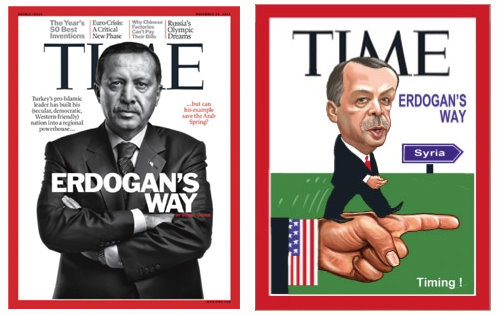
Left: When prime minister Erdoğan appeared on the cover of its Novemer 28th, 2011 issue of Time Magazine, Erdoğan and his supporters were thrilled. That week the cover featuring the prime minister appeared on every edition of Time save the US one.
Right: Musa Kart, cartoonist for the newspaper Cumhuriyet, made this parody that suggests the real reason Erdoğan was so honoured by TIME.
Will we be selling off relics of our Republic to curious
tourists in the near future? You know, like the Russian medals and East German
uniforms in Berlin? Was the same invisible hand behind the unbelievable
collapse of the Soviet giant? Is there a link between the reapparition and
popularization of the Ottoman coat of arms and the reintroduction of the
Romanov double eagle as the coat of arms of post-Soviet Russia?
Cover of the program of ceremonies for the baptism of Grand Duchess Maria Nikolaevna, 1899. She was murdered along with her father, Tzar Nicholas II and the rest of the Imperial family (and servants) by the Bolsheviks on July 17th, 1918.
(Image from the media.)
The Hammer and Sickle was known the world over but now it is gone. As the Soviet Union collapsed, losing territory, power, and influence, Russia resurrected the imposing symbol of a bygone age. This double-eagle is now mounted over the gateway to the Russian consulate general in Istanbul.
(Image from my own camera.)
The Ottoman coat of arms was practically forgotten by everyone except scholars. It started mushrooming all over the place in the '90's and is now practically a fashion.
(Images from my own camera.)
Russia took on
a symbol of lost power and glory at a time of tremendous loss of real power and
territory; is the Ottoman coat of arms the sugar to coat the approaching
secession of Turkey’s eastern provinces? The members of the Russian imperial
family, the Romanovs, murdered by the Bolsheviks in 1918, were canonized as Saints.
Reverentially kissing the sainted image of Tzar Nicholas II.
(Image from the media.)
Their remains were
reinterred in 1998 at the Church of St. Peter and Paul in St Petersburg, close
to their ancestors. Is there a parallel between the Orthodox-Tzarist mix that
is replacing Soviet ideology and the Islamic-Ottoman mix that is being used to
erase the Turkish Republic from history, as was the Soviet Union before it? Can
we speculate a connection between the US reaction to the August 1991 coup
aganst Gorbachev and the ongoing pseudo-legal liquidation of the Turkish Armed
Forces to forestall a coup against Erdoğan? Is Erdoğan Turkey’s
Gorbachev, with a mission to effect a change of regime?
Would I be stretching it if I speculated a parallel
between the death of Gen. Eşref Bitlis in a plane crash in 1993 and that of
Ret. Lieut. General and rising politician Alexander Lebed in a helicopter crash in
2002? Lebed had entered politics and had made a bid for the presidency,
finishing third in the 1996 elections. He had ideas like "preserving the
army is the basis for preserving the government”, and was not wanting for
popularity. Full-Gen. Eşref Bitlis was the Commander of the Gendarmerie. He was
of the opinion that American Forces
stationed in Turkey against Saddam Hussein should be made to leave, and
complained that the US was helping the PKK.

All of what I know as my country is being rent asunder
before my very eyes, and I have no say in it. I am told this is a democracy and
I should wait for the general elections. Even assuming the elections are fair-
and there are good reasons to assume they aren’t- Turkey will have lost a good deal more by then. The manic drive for a new constitution that we don’t even need
will end up splitting the country territorially and the nation psychologically.
The US is pressing to get the new constitution out because it suits its plans
for the new Middle East, the AKP is pressing for it because it’s the willing
puppet of the US, the “opposition” MHP is complaining but rubber stamping it
anyway because that’s what it’s there for, the "major opposition” CHP is raising a
bigger fuss but presses for a speedy resolution anyway because that’s its
mission, the BDP is pressing for it because the Kurds expect to get an
independent country out of the deal and don’t give a sh.. what kind of a primitive
medieval theocracy Turkey will be stuck with after they’ve upped and left- well, the way
the discussions are going it probably won’t be called Turkey anymore.
The AKP has attacked the Constitution from day one.
Enjoying a majority in parliament and the support of members of the
“opposition” at every critical juncture, it has changed one clause after another. And now it has finally
come against the “unchangeable clauses”. These clauses are:
1) The Turkish State is a Republic.
2) The Turkish Republic is a democratic, secular State
under Rule of Law, in a spirit of national solidarity and of justice,
respecting Human Rights, loyal to Kemalist Nationalism and to the main
principles delineated at the beginning.
3) The Turkish State, with its nation and territory,
compose an undivisible whole. It’s language is Turkish. It’s flag is the red
flag with a white crescent moon and star, as specified in the relevant law.
It’s national anthem is the “Independence March”. It’s capital is Ankara.
4) The declaration in clause 1, to the effect that the
form of government is a Republic, those in clause 2 delineating the qualities
of this Republic, and the precepts in clause 3 cannot be changed, nor may such
a proposal be voiced.
Because
clause 4 says the first three cannot be changed, the AKP wants to start with 4.
The TGB has openly declared that, if an attempt is made
to change these laws, they will use their legal right to resist. You can
witness their declaration near the end of the vidoclip of the article “Sailing for Samsun”, 4 August- Ağustos 2013.
There was a call to conscientious citizens to rally in
front of the Silivri prison compound
on the fateful Ergenekon judgement day of August 5th. No one expected the Silivri court to be any more just than
when it passed the Balyoz
“Sledgehammer” verdicts on September 21st, 2012. Still, no one could
afford to lose hope! The organizers of the rally clearly wanted a big, loud protest in front
of the prison walls that would call the atention of the world in the same way
the Gezi Parkı protests had done in
June. The government wanted nothing of the sort, and declared the area out of
bounds.
The Gezi Parkı protests of June 2013 attracted worlwide attention. This cartoon by Jan Plantureux ("Plantu") appeared in Le Monde.
The last thing the government wanted was this kind of publicity around the dubious justice of the Ergenekon trials.
The weekend started active. Two days before, on Saturday,
August 3rd, there was a series of early morning raids and searches aiming at
the TGB, the Labor Party, the Ulusal
channel, and the Aydınlık newspaper,
with a total of 14 taken into custody, including Aydınlık editor-in-chief İlker Yücel and TGB leader Çağdaş Cengiz.
Like others taken in custody on Aug. 3rd, TGB
leader Çağdaş Cengiz was released after the Silivri court passed its verdicts.
There will still be a court case against him.
(Image from the media.)
That evening there was gas and water again at the
shopping street İstiklâl Caddesi
leading to Taksim square and surrounding alleyways, where the police managed to
whip a small demonstration into a frenzy. Everything led to believe
the verdicts on Monday would be infuriating enough to ignite a major public
outcry, and the government was ready for a showdown.
The Silivri Watch has been a kind of guard of honor for the captives of the Ergenekon, "Sledgehammer" and related
cases. It has hosted and supported the families of the defendants and offered
refreshment and a place of rest to demonstrators since September 9th, 2011. The Watch has been there for almost two years now, around the clock, through all
kinds of weather. The heroic operation was spearheaded by retired municipal
worker Hıdır Hokka.
The tent of the Silivri watch, outside the prison compound.
(Image from my camera.)
Hıdır Hokka (right) with defendant Lieut. Mehmet Ali Çelebi (left) who was not held in custody during the trials- he continued on active duty in the southeast. The photo is from March 11th, 2013, and Lieut. Çelebi had to appear in court that day.
Hokka was kept away from Silivri on June 5th with searches and interrogations.
The verdict for Lieut. Çelebi was 16 years and 6 months.
(Image from my own camera.)
Hıdır Hokka still selflessly conducts his self-imposed mission. His
home was one of the places raided and searched on Saturday, August 3rd. He too
was taken into custody. He was called in for police interrogation on Monday, August 5th, the very day of the final hearing at Silivri.
On August 5th, from about 6:00 in the morning, hundreds
of gendarmes laid siege to the tent and containers of the “Silivri Watch”. The
area of the “watch” was evacuated and a search was launched that was to take as
long as the court was to have its final hearing. The pretext was a "letter by an
informant" that there were arms concealed in the area. Hıdır Hokka himself was
taken to detention directly from there.
From Sunday evening, August 4th, demonstrators
answering the appeal had started to assemble at the departure points of their
buses around the country, only to be obstructed by the police. Many buses were
not allowed to leave at all, some did manage to set off, only to be obstructed
along the way. Giving a play-by-play of the unfolding events, Ulusal asked
participants to keep trying to reach Silivri, and if totally unable, to hold
demonstrations wherever they were stopped.
On the morning of August 5th, myself and my wife got up
to the sound of the alarm clock, had a light breakfast and, joined by my wife’s
aunt, set out to the pick-up point for our bus. The rendez-vous had been set
for 7:00 a.m. and we got there on time but there were no buses, just distressed,
confused, frustrated people waiting. The bus drivers had been threatened by
the police and had relented.
The people assembled to heed the call but the buses weren't there!
(Image from my own camera.)
Some of the assembled citizens proposed to go
by alternative means, some thought we should follow the instruction of holding
demonstrations wherever we were stopped. The organizers (the Labor Party and
the TGB) made the decision: assemble at “the Bull”- a sculpture at a central crossroads in Kadıköy- and to hold a demonstration there while the organizers
looked for alternate buses.
No buses, so a demonstration will be held where we have been stopped. Demonstrators move to "the Bull" of Kadıköy.
(Image from my own camera.)
The early morning march of the group.
(Image from my own camera.)
The citizens of Kadıköy approaching "their Bull".
(Image from my own camera.)
We marched along the still deserted streets of Kadıköy,
shouting slogans. Once at “the Bull”, people ready to brave the sun huddled
around the statue at the center while the rest receded into the shade on the
sidewalks. A TOMA vehicle took up position facing us.
There was news that buses had been arranged for us, and by noon
they started to show up, filling up and moving on as they arrived. But they were
few, and widely intersperced. We decided to make our way with our own car, as
far as we could go, and I inquired about the best way to get there, the roads being blocked. A gentleman from
the Labor Party, who had come in from Yalova, asked whether he could join us. We went
home, picked up our car, and drove off.
On the way our new acquaintance (in the excitement we
never thought about asking his name) maintained telephone contact with friends
who had gone on ahead, and so kept abreast of developments. By the time we were
approaching the town of Silivri, we learned there had been gas and conflicts but
it was all over. The verdicts had been passed and everybody was trying to make
their way home. We decided to take him to the Labor Party offices in Silivri.
It was approaching 16:00.
We all went there, and got some news of the day’s events.
The sparks from the gas cannisters shot at demonstrators- some from
helicopters- had set fire to the dried weeds in the fields. (The pro-government
press was later to claim the demonstrators had started the fire).
"Hitherto shalt thou come, but no further!"
If you managed to slip through the intimidations, roadblocks and similar obstacles to reach Istanbul and from there to the turnoffs to the Silivri prison compound, you still got stuck at the final roadblocks. This is the coastal road; you can spot the sea behind. The prison compound is considerably inland; the sea is not visible from its hilly location. Reaching the compound means traversing the fields on foot.
(Image from the media.)
The people making their way over the fields. Some have travelled overnight only to be stopped at the turnoff.
(Image from the media.)
The government's defensive lineup against the ragtag and unarmed army of the people. (Image from the media.)

Like trying to reason with a wall!
(Image from the media.)
Of course, there was gas. Why am I not surprised?
(Image from the media.)
According to news reports, the sparks from cannisters set fire to the dried weeds covering the fields. The pro-government press blamed the demonstrators!
(Image from the media.)
While we were in the Labor Party office, three young men-
TGB members- came in, sweaty and scorched in the sun. We heard their accounts,
how they had made a makeshift barricade which was blown to pieces by the
pressurized water, how they had witnessed one of their friends receive a
powerful blow from a gas cannister. We also saw a few “souvenir” gas cannister.
According to the printed text on the cannisters, they are produced in the USA-
in Pennsylvania, the state that keeps popping up in this sordid story.
Gas cannister used on August 5th to keep demonstrators away from the Silivri compound.
Pennsylvania, the Liberty State!
(Images from my own camera.)
Hoping to save the situation the best they could, the
organizers of the protest called for a meeting at 18:00 at the Kadıköy ferry
piers to declare “the nation did not recognize the Verdicts.” This meant dashing back to our point of departure, a long distance and on the other side of
the Bosphorus, rendered even harder to get to by the mounting rush hour
traffic.
So off we went again, arriving fifteen minutes late. The
police lineup had taken its place, and we had until 19:00 to shout, protest,
and beat it. Speakers of the Labor Party, whose chairman had just been
condemned to life, vowed bitter and relentless struggle. The organizers wrapped up their fiery
speeches punctually. The assembled crowd, in a show of defiance, stayed on,
shouting slogans, waving flags, and photographing each other for another fifteen minutes, and then marched
up along Baghdad Avenue until they reached the Göztepe park, where the rally
turned into a forum.
Rally at the Kadıköy piers, August 5th 2013, 18:00-19:00,
(Image from my own camera.)
Police at the ready at
the Kadıköy piers area:
make sure you're done with your protesting at 19:00
sharp!
(Image from my own camera.)
The list of convictions is long, including generals,
officers, former rectors, journalists, authors, businessmen, secretaries,
thugs, hooligans, murderers. The purpose was to fabricate a connection between
the targeted persons and smear disrepute by throwing real criminals into the mix. If you
scan the long list of convictions, you will find, with exceptions, a reverse
relationship between the length of the sentence and respectability.
Here are just the life sentences with their
professions, in alphabetical order, so that you can judge the mixture yourselves:
- Alpaslan Arslan (Lawyer,
hitman of the 2006 attack on the Danıştay,
the Council of State): twice life without parole + 90 years.
- Ret. Full Gen. İlker Başbuğ,
former Chief of Staff: life.
- Ret. Nav.
Capt. Dursun Çiçek: Life without parole.
- Sevgi Erenerol (former press secretary of the
Orthodox Patriarchate): life.
- Ret.
Lieut. Gen. Mehmet Eröz: life.
- Ret. Full Gen. Şener Eruygur: life.
- Ret. Full Gen. Hasan Iğsız: life.
- Ret. Col. Fikri Karadağ: life without parole.
- Kemal Kerinçsiz
(lawyer): life without parole.
- Ret. Brig. Gen. Veli Küçük: twice life without parole + 99 years 1 month.
-Mustafa Özbek
(Chairman of the Metalworkers’ Union): life.
- Doğu Perinçek
(chairman of the Labor Party): life without parole.
- Ret. Col.
Fuat Selvi: life.
- Ret. Full
Gen. Nusret Taşdeler: life.
- Ret. Capt.
Muzaffer Tekin: twice life without parole + 99 years.
- Ret. Full
Gen. Hurşit Tolon: life.
- Ret. Nav. Lieut. Hasan Ataman Yıldırım: life without parole.
The first on the list -Alparslan
Arslan- is really a killer, the one who carried out the attack on the State
Council (Danıştay) on May 17th 2006;
a disturbed soul who thought prayers made him invisible. This crime, and the bomb attacks on the left-wing newspaper Cumhuriyet, mentioned earlier, provided the judges with the violent
acts that were missing from the Ergenekon
scenario.
The matter had already been judged and a verdict given in Ankara years ago, with Alparslan
Arslan and instigator Osman Yıldırım receiving life, but then the matter was
mixed into the Ergenekon soup. The Ergenekon prosecutors met with Yıldırım
in prison and got the desired incriminations. Yıldırım must have received
promises and assurances. At the close of the hearing on August 5th Yıldırım was
set free.
After the fateful August
5th, 2013, day of suppressed protests, a new witchunt was instigated immediately, just as it had been
following the Gezi events; smear campaigns, interrogations, the pro-government
press pointing fingers, giving the signal that Erdoğan and the AKP promise
nothing but more of the same.
The military intervention of June 30th 2013 in Egypt and
the US refusal to condemn it scared our own fundamentalist strongman Erdoğan
and he has taken Morsi’s fall like a personal affront to himself.
Turkey stands practically alone in its unqualified support of the
fundamentalist Egyptian leader. At the same time the bloodbath in Egypt that
ensued from struggles between the government forces and Morsi supporters has
provided Erdoğan and the AKP with the opportunity of seeming to take the moral
high ground. Next week we should be observing August 30th, Victory Day, the
national holiday most closely associated with the Armed Forces, the nemesis the
AKP has been trying to crush!
Now the government has
started cancelling August 30th celebrations to respect the fallen of the
pro-Morsi demonstrators in Egypt. And the Labor Party-TGB-Ulusal-Aydınlık front has
announced its intent to celebrate to the full, appealing once again to the
public to join in!
20-22 July 1995, 350 Srebrenica refugees who surrendered
to the Republika Sirpska militia near the village of Meces were forced to
dig their own graves and shot. This is the latest date for Srebrenica-related murders I have found.
March 26th-July 24th 1999.
Turkey is a unitary nation-state composed of many ethnic groups who are
expected to accept the national identity “Turkish”, other ethnic identities
being subordinate to that. The Lausanne treaty of 1922 obliges Turkey to
recognize citizens of Greek and Armenian origin as “minorities”, which give
them special rights, like their own schools. The Jews have waived that option,
choosing to be considered 100% Turkish, thus part of the majority, which has
not hindered them from maintaining and attending their synagogues and teaching
whatever language they wish to their children, provided that they, like all
other citizens, also speak Turkish. The Kurds have not been given special
minority rights, and due to several uprisings in Turkish history, their
strivings for linguistic and cultural rights have been looked upon with
suspicion. Adding to the difficulty is the fact that the Kurds live in the
border regions of four different countries- Turkey, Syria, Iraq and Iran, so
any move towards unity threatens the territoral integrity of four nations.
Because they were not considered a minority, the Kurds of
Turkey have had access to all kinds of jobs, even in the Armed Forces and
government, all the way up to prime minister and president. The real obstacle to their
happiness has been the poverty of the region, the poor level of education
caused by the poverty and the remoteness, and directly linked to this, the
abuse of the citizenry through village lords (ağa) who oppress the villagers and suck their bloods dry. The ağa system is unofficial
feudalism tolerated and even supported by politicians because an ağa brings in the vote of the whole
village. The famous novel “Mehmed my Hawk” (İnce
Memed) by ethnic Kurdish author Yaşar Kemal exposes the system.
When the PKK came on the scene, waging guerilla war
against the Turkish state, it readily found recruits among the discontented
youth in the villages. The first thing the PKK had to do was to keep the population
discontented, since any betterment of
their lot would weaken their will to resist. So machines for building roads
were set on fire and teachers were abducted and shot.